For veterinary practices and animal hospitals
Veterinary marketing on Google Maps
Your catchment is wider than Google thinks. So is your species list.
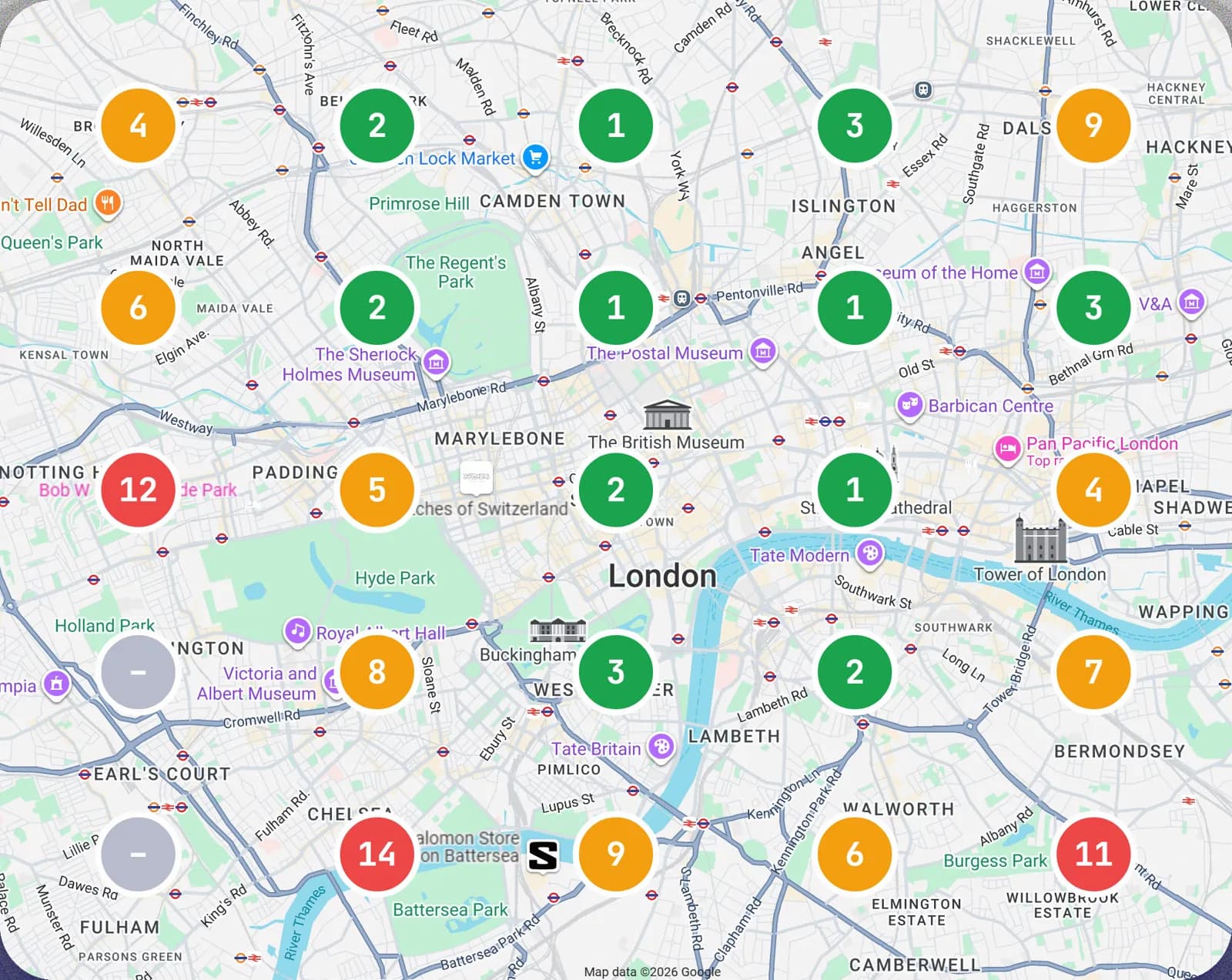
“Emergency vet near me”, “farm vet” and “rabbit vet” are searched from different distances, and each returns a different three practices. The scan takes about a minute and shows which you are in.
Map © Google
Why veterinary is different
You are two businesses on one listing.
Nobody drives past two practices with a howling carrier on the back seat. For small animal, ten minutes is the whole decision. The farmer picking who comes out to a downer cow is choosing from thirty miles, because there you do the driving.
A Google profile only holds one of those shapes unless somebody sets the other. A veterinary listing needs both, and on most only one has ever been filled in.
You can be the only practice for thirty miles that will look at a rabbit, and be listed as none of it.
Primary category was “Veterinarian” and nothing else
Emergency and equine drafted underneath it
No service area set, so the farm work stopped at the postcode
Coverage drafted for the ground your vets drive
Rabbits, reptiles and birds mentioned nowhere on the profile
All three drafted for the profile
Eight reviews this year with no reply
A reply drafted for each
The out-of-hours provider was named nowhere
Referral line drafted for the description
Nothing posted on the profile since spring
A post drafted for this week
It shows what the agent looks for and what it does about it.
Meet the agent
Rank Pilot holds your place on every one of those maps.
Out of hours, the profile is the only receptionist you have. Rank Pilot is the AI agent that keeps it right: it audits the profile every month, drafts what is missing, from the species list to the ground you cover, and emails you every Monday with what moved. Nothing goes out until you have read it and saved it, so no case detail reaches the page without you.
- This week
Switched its main category to emergency vet
- This week
Climbed past you for “vet near me”
- Last week
Fourteen new photos since the last scan
- 2 weeks ago
Eleven new reviews in a fortnight. You took three.
A constructed example of the competitor feed. Real entries name the practice that moved.
What it does
Six jobs nobody at the practice has to remember.
None of this gets skipped because a practice disagrees with it. It gets skipped because Tuesday happens. Rank Pilot does it anyway, on a schedule.
- 1
Reads your position at 25 points, not at the door
Google gives a different answer in every village, so your position is read at 25 points every week.
- 2
Sets how far you reach
The address small-animal clients come to, and the ground your vets cover for farm calls, both drafted for the profile. Most practices have only one set.
- 3
Lists every animal you treat
Rabbits, reptiles, birds, farm, equine, dentals, orthopaedics, ultrasound, home visits. An owner with a rabbit types rabbit.
- 4
Drafts a post every week
Vaccination season, the new ultrasound, the Saturday clinic. Published once you save it.
- 5
Answers the angry review, and the grieving one
The out-of-hours fee, the dog that did not come home. Reviews are pulled every four hours and each reply never discusses the case. Saved by you, it is published two hours later when Autopilot is on.
- 6
Tells you who else is climbing
Every Monday: your rank across the map and the practices nearby that gained reviews or changed category. Once a month, whether ChatGPT, Gemini, Google AI and Ask Maps name the practice.
The vet practice Google Maps check shows where the practice ranks across the town and the farms, and who holds the top three. Rank Pilot then drafts replies to veterinary reviews and tracks the practices ahead of you, so you can outrank the vets nearby.
What actually happens, and when
Week one is admin. Month three is ranking.
Pet owners often choose a vet once and stay for the animal’s whole life, so they read carefully first. Google also waits before trusting a rewritten profile, and the weekly scan shows when it does.
- Week one
Hours and the out-of-hours arrangement checked. The ground you cover drafted alongside the address, and every species and service listed, ready for you to save.
All of it visible on your own profile. You can check every item yourself.
- Month three
About where the map starts to shift, once a profile that describes the whole practice has answered reviews and weekly posts behind it.
Usually. Not always, and never guaranteed by us.
What changes on the phones.
The same profile, twice: the one nobody has a spare hour to own, and the one Rank Pilot works on every week.
Doing it yourself
- Holiday hours and the out-of-hours line are whatever somebody typed years ago.
- The listing reaches the postcode the practice sits in. The farm work is invisible past it.
- The profile says “veterinarian” and nothing about rabbits, farm calls or dentals.
- A review written at midnight by a grieving owner sits there for a week.
With Rank Pilot
- Hours and the referral line checked in the monthly audit, and flagged when something looks wrong.
- Address and ground covered both set, so the profile reaches as far as your vets drive.
- Every species and service written down in the words owners type.
- A reply drafted in your voice, waiting for you to read, change and save.
Rank Pilot never writes, buys or incentivises a review.
$79 a month per practice, small animal and farm work on one profile. A 7-day trial, no card.
Straight answers
Veterinary marketing: the questions practices ask.
We refer out of hours. Will this make us look like a 24-hour hospital?
No. Rank Pilot works from your real rota. If you close at seven and refer overnight, the profile should say that, including who covers you. Being accurate about when you are shut is worth as much as being open.
Can it reply to a review about a pet that died?
Rank Pilot drafts one, and nothing goes out until you save it. A draft for a loss acknowledges it and offers to talk privately; you can change any word, and leave out the animal, the treatment and the bill.
We do farm and equine work as well as small animal.
Then you are running two businesses off one listing. The farm and equine side is service-area work: the ground you cover. Rank Pilot drafts both, and “farm vet” or “equine vet” can be tracked apart from “vet near me”.
How long before anything changes?
Two clocks. The profile work is drafted in week one: hours, the out-of-hours line, the ground you cover, every species and service. The map is the slow one, usually 30 to 90 days.
Does Google’s Ask Maps recommend vets?
It can, from what Maps knows about a practice, including the species and hours on its profile and its reviews; here is how Ask Maps picks a business. Rank Pilot checks every month whether Ask Maps names your vet practice.